How Long Should a Resume Be? The Definitive Guide for Job Seekers
 Angelina Koss7 min read
Few questions spark more debate in job searching than this: how long should a resume be?
Ask three recruiters, and you will likely get three different answers. One might claim that anything over a single page lands straight in the trash. Another will insist that cutting out your accomplishments just to squeeze onto one page sells your career short.
So, what is the right answer?
For most professionals, a resume should be one to two pages long. The exact length depends directly on your career level, industry, and the depth of your measurable accomplishments.
In this comprehensive guide, we break down resume length by experience, explore when to choose a one page resume versus a two page resume, and share recruiter-tested strategies to format your document for both human eyes and Applicant Tracking Systems (ATS).
Resume Length Quick Guide: How Many Pages Do You Need?
If you are looking for a quick rule of thumb, use this breakdown:
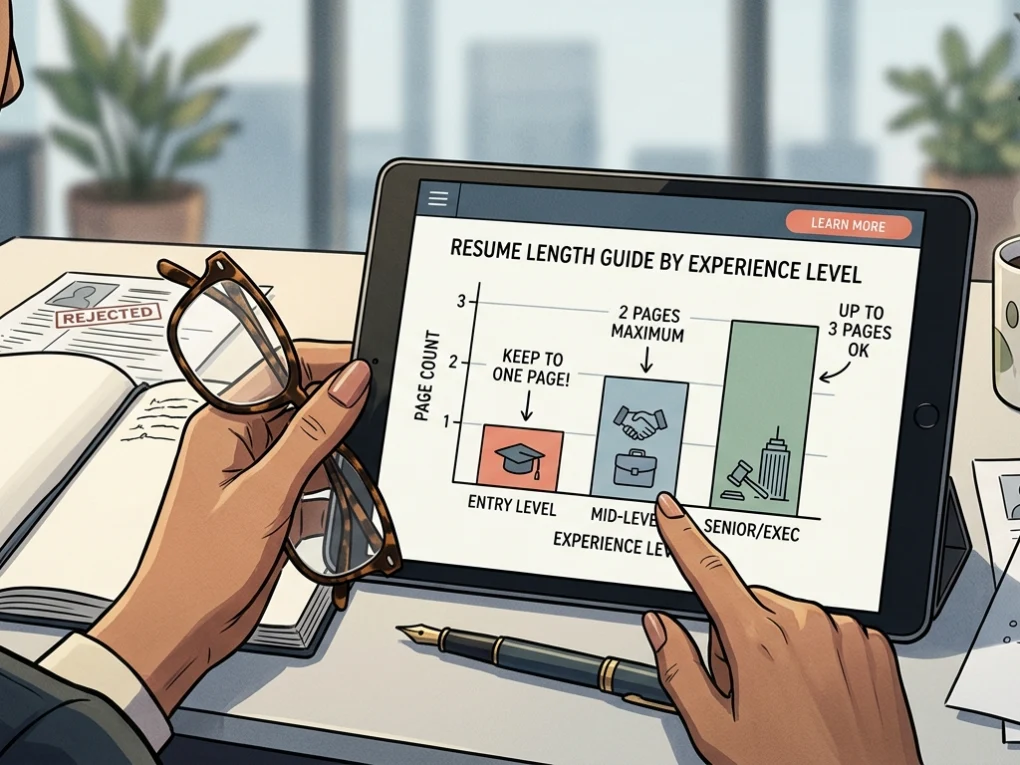
| Experience Level | Recommended Length | Best Suited For |
| 0–9 Years | 1 Page | Students, recent graduates, entry-level candidates, career changers |
| 10+ Years | 2 Pages | Mid-career professionals, senior managers, technical specialists |
| Specialized / Senior | 3+ Pages | Academic CVs, scientific research, medical staff, executive leadership |
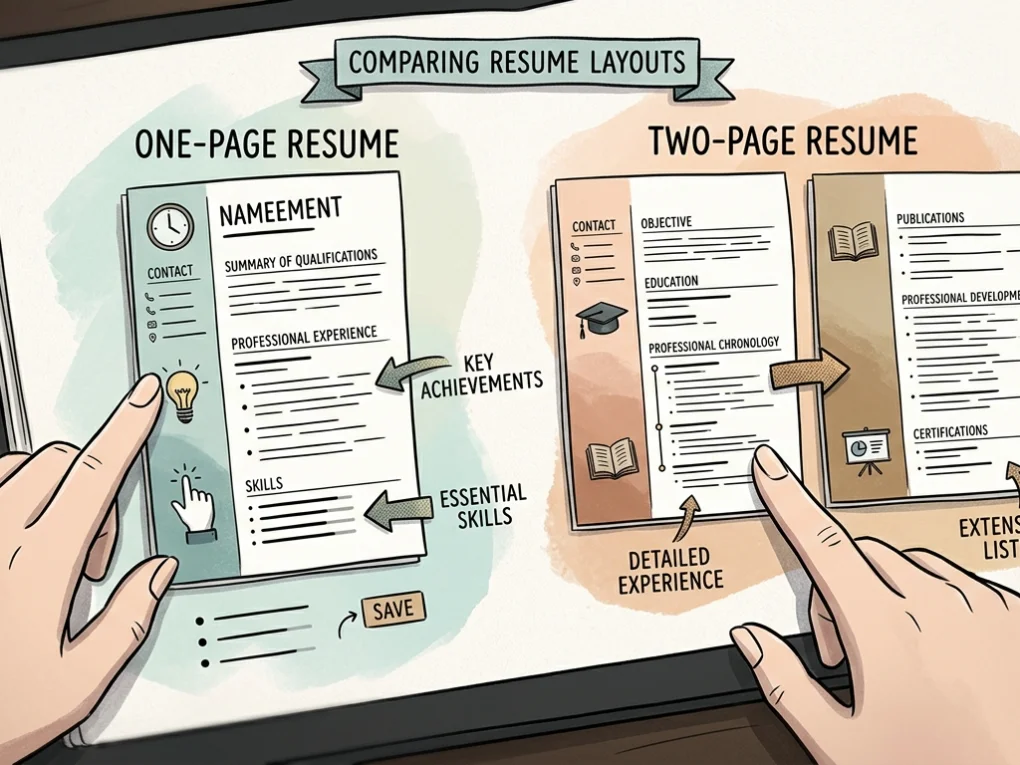
When to Use a One Page Resume
For decades, the one page resume stood as the undisputed golden standard. While modern hiring norms have relaxed, a single page remains the strongest choice for a large portion of job candidates.
Recruiters spend an average of six to seven seconds on their initial scan. A concise, single-page document makes it effortless for them to spot your top qualifications right away.
You should stick to a one page resume if:
- You are a student or recent graduate: If your career history consists primarily of internships, volunteer roles, and coursework, keep it to one page. Do not add fluff simply to stretch the page.
- You have under 10 years of experience: If you have held two or three positions since graduating, your highest-impact achievements will fit comfortably on a single sheet.
- You are making a career pivot: When transitioning into a new industry, your past day-to-day duties may not directly apply. Keep your transferable skills and relevant wins tightly focused on one page.
- The job posting explicitly requests one page: Certain competitive graduate programs, investment banks, and consulting firms specifically enforce a strict one-page limit. Always follow employer guidelines.
Pro Tip: If you are unsure whether your background requires a business resume or an academic curriculum vitae, read our breakdown on resume vs CV to pick the right format from the start.
When to Use a Two Page Resume
A two page resume is not just acceptable—it is often preferred for experienced talent.
Condensing a 15-year career into a single page forces you to cut valuable metrics, context, and project milestones. Squeezing margins or shrinking your font down to 8pt makes your document unreadable.
You should use a two page resume if:
- You have 10 or more years of relevant experience: Seasoned professionals usually have a track record across several employers or key promotions that warrant additional room.
- You work in a technical or specialized field: Software engineers, data architects, project managers, and engineers often need space to list technical skill stacks, industry certifications, and key project deliverables.
- You manage teams and budgets: Leadership roles require showing both your operational duties and business impact, such as revenue growth, team expansion, and cost reductions.
When Does a Resume Need 3 or More Pages?
The vast majority of corporate job seekers should avoid exceeding two pages. However, exceptions exist:
- Academic and Medical CVs: Medical professionals, researchers, professors, and scientists frequently use multi-page documents to catalog peer-reviewed publications, clinical trials, teaching fellowships, and grants.
- Federal Government Jobs: Federal applications (such as USAJOBS in the United States) demand exhaustive detail on past pay grades, hours worked, and specific agency compliance. Even so, many federal agencies now place strict caps on resumes (often 2 to 5 pages maximum). Always read agency directives before submitting.
- C-Suite and Board Executives: Senior corporate executives with 25+ years of board seats, acquisitions, and public speaking credits may require a third page.
Matching Resume Length by Experience: A Closer Look
To ensure your resume matches hiring expectations, let’s look at resume length by experience stage by stage.
Entry-Level (0 to 3 Years)
At this stage, your priority is relevance over volume. Focus on education, relevant projects, technical certifications, and quantifiable wins from internships or entry-level positions.
-
Target: Exactly 1 page.
Mid-Career (4 to 9 Years)
You have established a solid career footing and held two to four distinct roles. While some professionals naturally spill over, sticking to one page is still ideal unless you have a dense project catalog.
-
Target: 1 page (or 2 pages if your achievements genuinely require the space).
Senior & Management (10+ Years)
You now have significant responsibilities, direct reports, and business-critical contributions. Squeezing this onto a single sheet obscures your career trajectory.
-
Target: 2 full pages.
4 Critical Rules for Resume Formatting
Knowing how long should a resume be is only half the battle. How you structure and balance that space determines whether an employer reads your document.
Rule 1: Avoid the “Spillover” Trap
Never submit a resume that bleeds 3 to 5 lines onto a second page. Leaving an almost-empty second sheet signals poor planning.
- If you move to page two, ensure your content fills at least half to two-thirds of the second page.
- If you only have a few trailing lines, trim bullet points, adjust line spacing, or slightly tighten margins (never less than 0.5 inches) to pull everything back to one page.
Rule 2: Limit Your Work History Depth
A standard resume is not an autobiography. You do not need to list every summer job or retail position from college.
- Focus closely on the last 10 to 15 years of relevant experience.
- Jobs older than 15 years can be removed entirely or grouped into an “Earlier Experience” section with just the company name, title, and years.
Rule 3: Quality Over Quantity
Do not pad your experience with lists of routine tasks. Replace passive phrases like “Responsible for handling customer inquiries” with results-driven statements:
-
“Resolved 45+ daily client escalation tickets, improving customer satisfaction scores by 18% in Q3.”
Aim for 3 to 5 high-impact bullet points per position.
Rule 4: Balance White Space and Readability
Keep font sizes between 10pt and 12pt for body copy and 14pt to 16pt for section headers. Clear margins (0.75″ to 1″) and bulleted lists ensure your resume passes both automated parsing and recruiter review without visual fatigue.
How to Shorten Your Resume Without Losing Value
If your resume currently sits at an awkward 1.5 pages, use these trimming tactics:
- Remove the Objective Statement: Replace outdated objective statements with a sharp 2-to-3 sentence Professional Summary—or eliminate it altogether if your experience speaks for itself.
- Cut “References Available Upon Request”: Employers already know you will provide references when asked. This phrase wastes prime page space.
- Eliminate Wordy Filler: Cut filler phrases like “successfully managed,” “tasked with,” or “duties included.” Start immediately with strong action verbs: spearheaded, delivered, optimized, launched.
- Consolidate Contact Information: Display your name, phone number, email, location (City, State), and LinkedIn URL on one or two header lines instead of stacking them vertically.
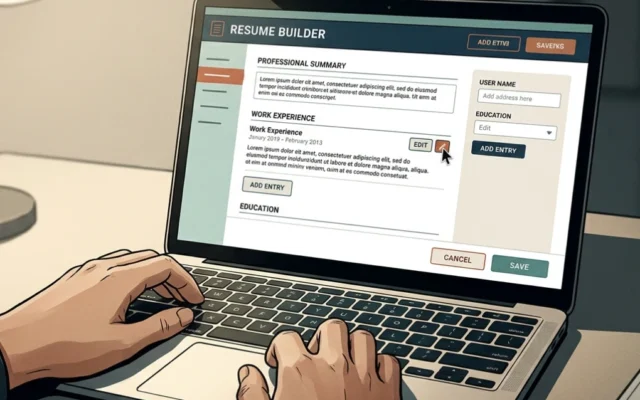
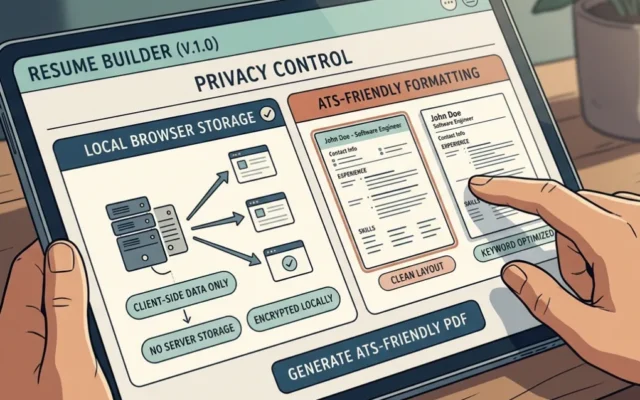
If formatting margins and spacing by hand feels overwhelming, using a professional resume builder can automatically balance font sizes, spacing, and page splits for you.
Frequently Asked Questions (FAQ)
Can a resume be 2 pages if I only have 5 years of experience?
Generally, no. Unless you have worked on an extensive portfolio of technical projects, research publications, or distinct client contracts, five years of experience should comfortably fit on a single page. Focus on editing down your bullet points.
Do recruiters actually read two-page resumes?
Yes. Recruiters regularly read two-page resumes for mid-level and senior candidates. As long as the content on page one captures their interest and page two contains relevant, high-impact accomplishments, a multi-page document is completely standard.
Does an ATS penalize two-page resumes?
No. Applicant Tracking Systems parse text regardless of page count. However, keeping your document cleanly formatted in standard .docx or .pdf formats ensures that your information imports correctly into the recruiter’s database.
When determining how long should a resume be, remember that relevance always beats length. A tight, well-crafted one page resume is vastly superior to a two-page document stuffed with filler. At the same time, an accomplished professional should never compromise clarity just to stay on one page.
Tailor your document to your career stage, highlight measurable outcomes, and make every line earn its spot.
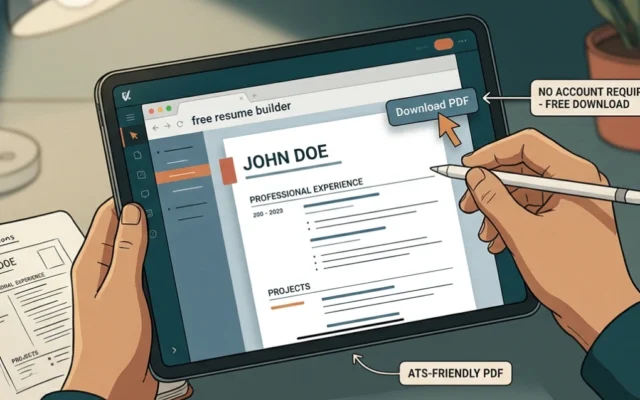
Ready to create a clean, recruiter-approved resume that fits your experience level? Explore our easy-to-use resume builder to build, format, and download your tailored resume in minutes.