Resume vs CV: What Is the Difference and Which Should You Use?
 Angelina Koss6 min read
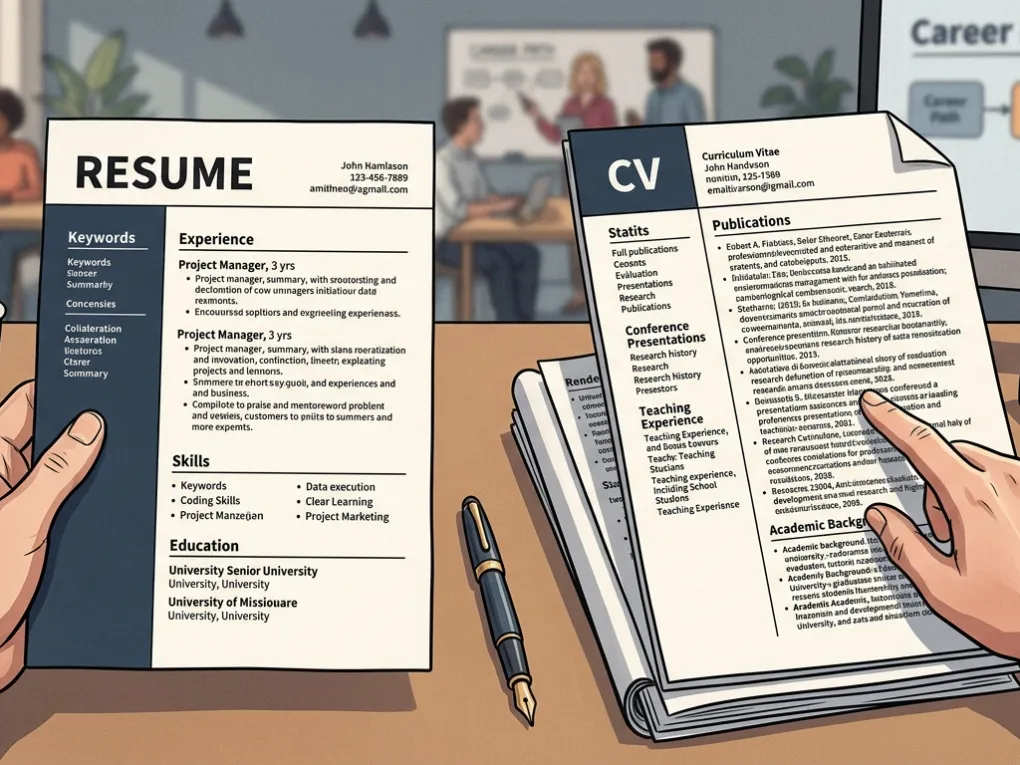
Understanding the difference between a resume vs CV can mean the difference between landing an interview or having your application overlooked. While people often use the terms interchangeably in casual conversation, recruiters, hiring managers, and academic committees treat them with distinct expectations depending on your industry and country.
A resume is a concise marketing document designed to summarize your most relevant career highlights for a specific job. A curriculum vitae (CV), Latin for “course of life,” is an exhaustive record documenting your entire academic, scholarly, and professional journey.
Core Differences: Resume vs Curriculum Vitae
To choose the right document, examine how their core parameters diverge across structure, volume, and intended audience.
| Feature | Resume | CV (Curriculum Vitae) |
| Primary Purpose | Targeted marketing document for private and public sector jobs | In-depth record for academic, medical, and scientific roles |
| Typical Length | 1–2 pages | 3–10+ pages (grows with career achievements) |
| Scope of Content | Selected relevant employment history and hard/soft skills | Comprehensive timeline of degrees, publications, research, and grants |
| Customization | Tailored specifically for every job opening and ATS system | Static chronological record; expanded rather than rewritten |
| Geographic Norm (US/CA) | Standard corporate application document | Reserved strictly for academia, fellowships, and research |
| Geographic Norm (UK/EU) | Term rarely used; synonymous with a UK standard CV | Standard 2-page application document for all jobs |
What Is a Resume?
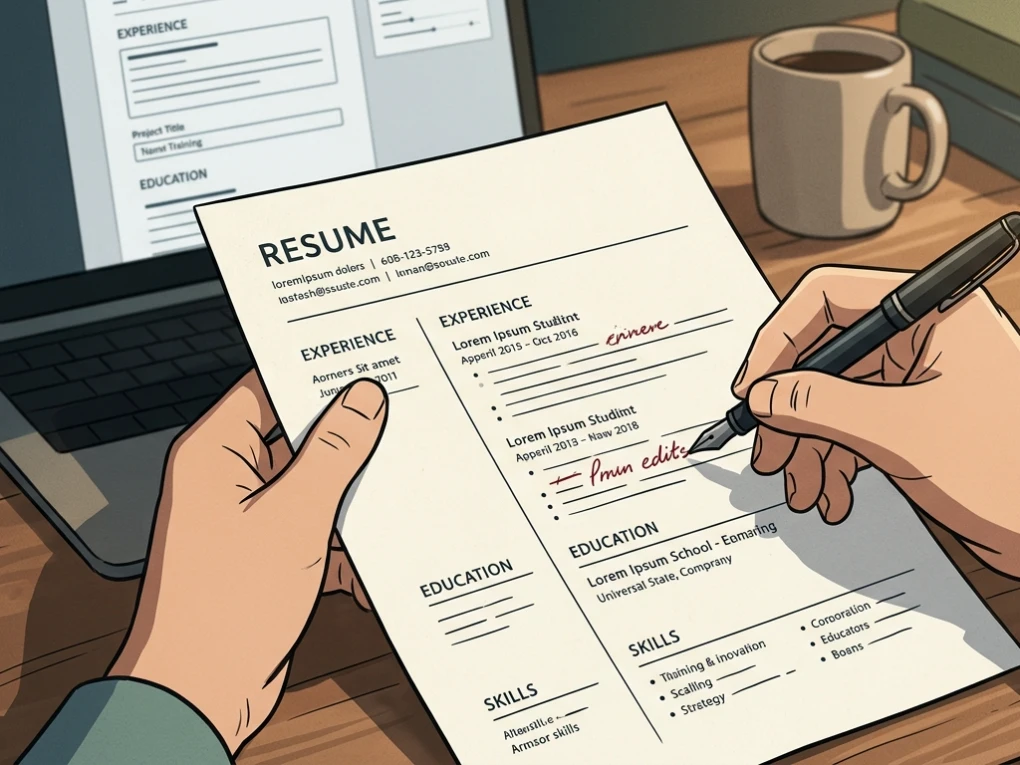
A resume is a brief, focused snapshot of your professional qualifications, work experience, and competencies. The goal of a resume is not to list every task you have ever performed, but rather to persuade a recruiter that you possess the exact skills required to excel in a targeted role.
Most hiring managers spend roughly 6 to 7 seconds scanning an application. Therefore, a resume must be scannable, results-driven, and optimized with keywords that pass Applicant Tracking Systems (ATS).
Typical Sections of a Resume
- Contact Information: Name, phone number, email address, LinkedIn profile, and location (city/state).
- Professional Summary: A 3 to 4-sentence overview capturing your top achievements and core specializations.
- Work Experience: Reverse-chronological employment history focused on measurable accomplishments rather than routine duties.
- Education: Degrees earned, institutions attended, and graduation years (honors optional).
- Skills: Core hard technical competencies and targeted soft skills aligned with the job description.
- Certifications & Awards: Industry-recognized credentials that validate your expertise.
For questions regarding ideal length across experience levels, refer to our comprehensive guide on how long should a resume be.
What Is a CV (Curriculum Vitae)?
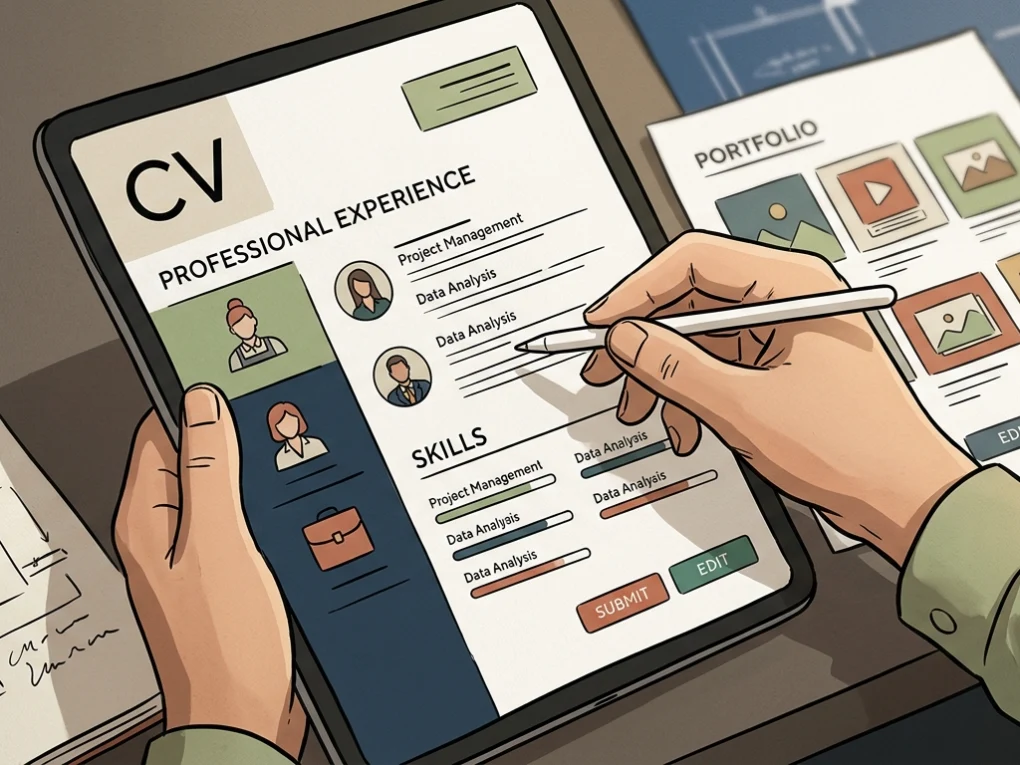
A curriculum vitae is a living, multi-page record detailing your scholarly accomplishments, pedagogical credentials, and intellectual contributions. Unlike a resume, which prunes older positions to conserve space, an academic CV expands continually as your career progresses.
In the United States and Canada, a CV is used almost exclusively when applying for university faculty positions, research fellowships, scientific grants, clinical medical appointments, and doctoral programs.
Typical Sections of a CV
- Academic Background: Detailed post-secondary degrees, dissertation topics, and committee advisors.
- Research Experience: Laboratory appointments, scientific investigations, and institutional projects.
- Teaching Experience: Courses instructed, guest lectures, curriculum development, and teaching assistantships.
- Peer-Reviewed Publications: Books, journal articles, chapters, book reviews, and editor roles.
- Conferences & Presentations: Keynote addresses, papers delivered, poster presentations, and panel discussions.
- Grants, Fellowships & Honors: External funding secured, competitive scholarships, and academic accolades.
- Professional Affiliations & Service: Academic committee service, peer review panels, and disciplinary societies.
The International Factor: Why Geography Matters
The single largest source of confusion when analyzing the difference between cv and resume stems from geographic location. What a recruiter expects hinges directly on the region in which the position is located.
United States and Canada
In North America, the two documents remain fundamentally separated:
- Resume: The mandatory document for corporate, commercial, non-profit, tech, and retail positions.
- CV: Reserved strictly for academia, higher education, scientific labs, medical fellowships, and grant applications.
United Kingdom, Ireland, and Europe
Across the Atlantic, standard business terminology shifts:
- CV: The everyday document used to apply for general corporate jobs. A standard UK or European CV is functionally identical to a North American resume—concise, targeted, and generally limited to 1–2 pages.
- Academic CV: When European institutions require an exhaustive record of research and publications, they specifically request an “Academic CV” to distinguish it from a standard corporate CV.
- Resume: The word “resume” is rarely used in daily hiring and is widely viewed as American phrasing.
Australia, New Zealand, and India
In regions such as Australia, South Africa, and India, employers frequently use “CV” and “resume” interchangeably in online job boards. Unless you are applying for a teaching, medical, or research chair, corporate recruiters in these markets almost universally seek a concise 1- to 2-page document focused on tangible business results.
How to Decide: Which Document Do You Need?
To ensure your application aligns with recruiter expectations, evaluate your industry and target country:
Choose a Resume if:
- You are applying for a corporate, private sector, start-up, non-profit, or government position in the US or Canada.
- The posting requests a focused summary of your work achievements and technical skills.
- You need to pass an automated ATS scanner tuned for rapid keyword matching.
Choose a CV if:
- You are applying for a faculty appointment, postdoc, lectureship, or research assistantship anywhere in the world.
- You are submitting an application for a scientific grant, academic fellowship, or medical residency.
- You are applying for general corporate jobs in the UK, Europe, or Commonwealth nations that label their standard application a “CV”.
If you are transitioning into a new role and want to ensure proper formatting and section hierarchy, you can explore our full analysis of resume vs CV or use a dedicated resume builder to produce clean, ATS-compliant layouts.
Frequently Asked Questions (FAQ)
Can I submit a CV instead of a resume for a corporate job in the US?
No. Submitting an exhaustive multi-page academic CV for a standard business role in the US can harm your chances. Corporate recruiters want a concise 1- to 2-page document highlighting role-specific accomplishments, not a comprehensive list of every presentation or project you have completed.
How many pages should an academic CV be?
An academic CV has no rigid page limit. Graduate students and early-career postdocs frequently produce CVs of 2 to 4 pages, while tenured professors and senior research scientists often have CVs spanning 10 to 20+ pages to accommodate extensive publication lists and grants.
Should I include a photo on my resume or CV?
In the United States, Canada, and the United Kingdom, never include a photo on your resume or CV unless explicitly requested (e.g., acting or modeling). Photos introduce potential employment discrimination risks under regional hiring laws. However, in certain European and Asian markets, professional headshots remain common practice.
Does an ATS read CVs differently than resumes?
Applicant Tracking Systems process both documents similarly by extracting text, contact details, dates, and skill keywords. However, because resumes are structured around targeted job titles and concise bulleted metrics, they generally achieve higher match rates in standard corporate ATS software compared to dense, multi-page CVs.
Craft Your Next Career Step
Choosing between a resume vs curriculum vitae comes down to knowing your audience and respecting regional hiring customs. Tailoring your document to match the exact requirements of the job posting ensures that your true achievements stand out clearly to hiring teams.
Ready to build a clean, recruiter-approved application? Visit our resume builder to select professional templates, format your sections effortlessly, and download an ATS-optimized file ready for your next career move.