How to Write Resume Bullet Points That Actually Land Interviews (With Formulas & Examples)
 Angelina Koss8 min read
Recruiters don’t read resumes word for word on the first pass—they scan them. When a hiring manager opens your application, their eyes go straight to the bullet points under your work experience.
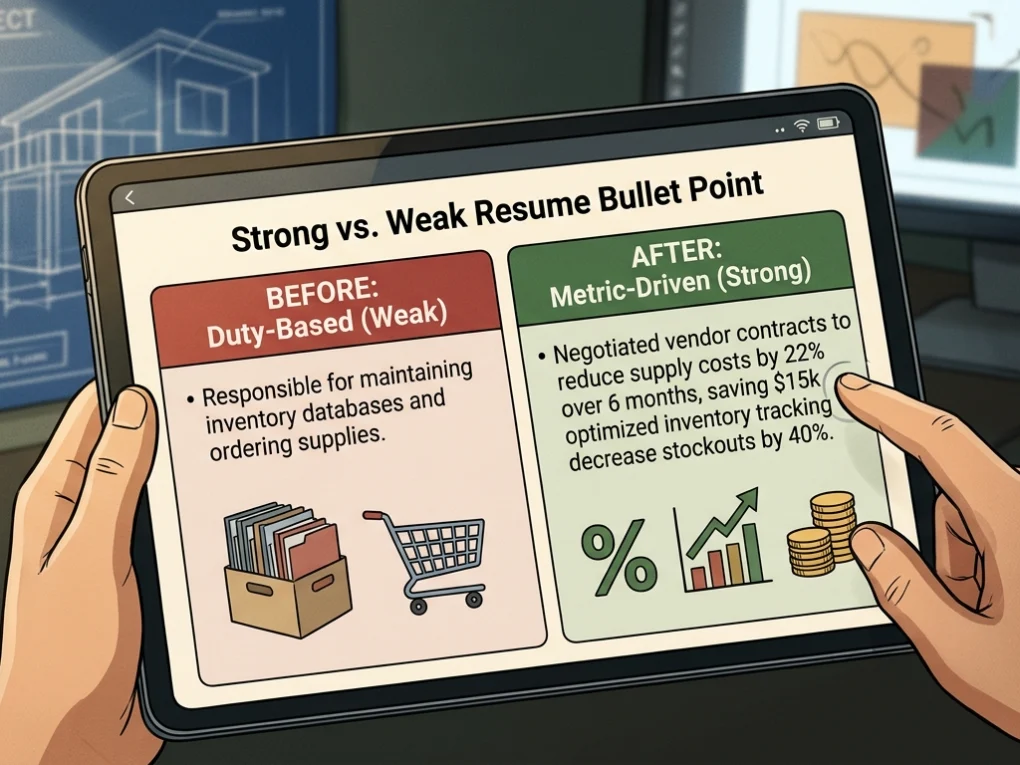
If your resume reads like a copy-pasted job description full of phrases like “Responsible for…” or “Duties included…”, it will blend in with hundreds of other applicants. Strong resume bullet points don’t just list what you were supposed to do; they prove how well you did it.
Whether you are figuring out how to write a resume from scratch or refreshing an outdated career history, mastering the art of the bullet point is the fastest way to turn applications into interview invites.
Why Most Resume Bullet Points Fail (Duties vs. Accomplishments)
The biggest mistake job seekers make when learning how to write resume bullet points is confusing duties with accomplishments.
A duty describes a task assigned to anyone holding your job title. An accomplishment shows the unique value, efficiency, or revenue you brought to that role. Hiring managers already know what a Marketing Coordinator, Software Engineer, or Registered Nurse does day to day. They read your bullet points to see what changed for the better because you were in the seat.
| Feature | Weak Bullet Points (Duty-Based) | Strong Bullet Points (Accomplishment-Based) |
| Opening Word | Passive phrases (“Responsible for,” “Helped with”) | Strong action verbs (“Spearheaded,” “Streamlined”) |
| Focus | Daily routine and basic job expectations | Tangible outcomes, solutions, and business impact |
| Evidence | Vague generalizations (“Handled many clients”) | Hard metrics, percentages, and timeframes |
| Recruiter Takeaway | “They occupied the role.” | “They drove measurable results in the role.” |
3 Proven Formulas for Writing Impactful Bullet Points
You don’t need to be a professional copywriter to write persuasive resume bullets. Career centers at institutions like Yale, Harvard, and the University of Arizona recommend using structured formulas to turn flat tasks into high-impact statements.
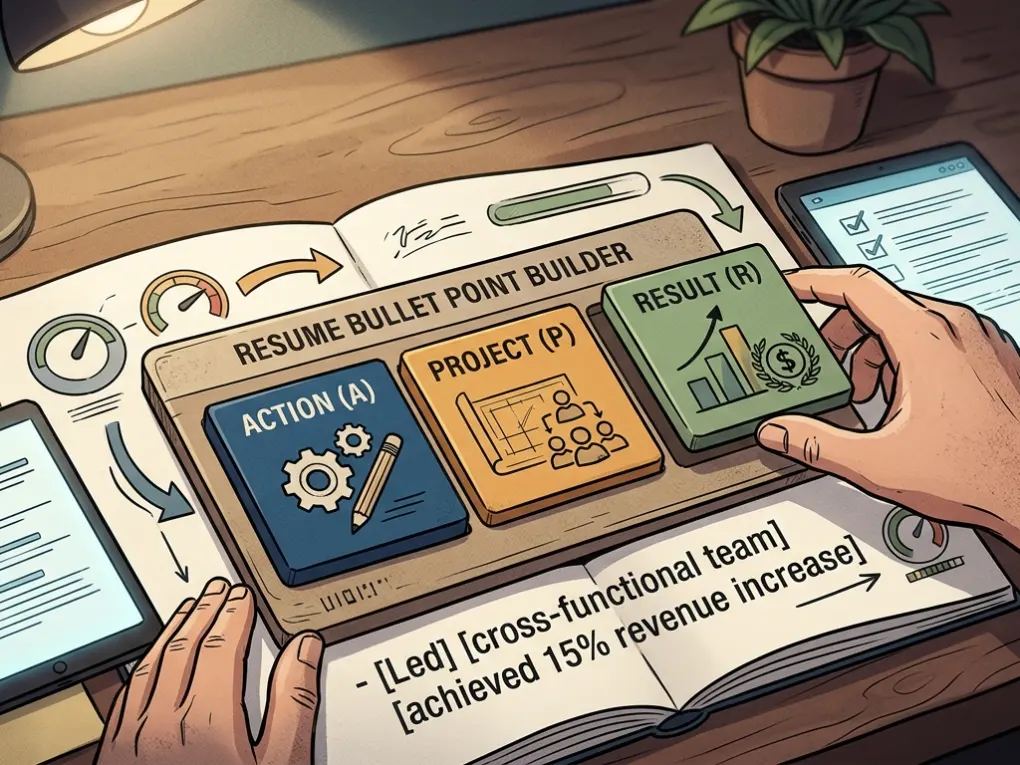
The APR Formula (Action + Project/Task + Result)
The APR method is the most versatile framework for any industry. You start with a dynamic verb, state the project or task you tackled, and finish with the tangible outcome.
- Formula: [Action Verb] + [Project or Task] + [Measurable Result]
- Example: Designed new client onboarding templates, cutting preparation time by 30% across a 12-person account management team.
The Google XYZ Formula
Popularized by former Google recruiting executives, the XYZ formula puts the impact at the very front of the sentence. This is ideal when you have impressive numbers that you want a skimming recruiter to see immediately.
- Formula: Accomplished [X] as measured by [Y], by doing [Z].
- Example: Increased organic website traffic (X) by 45% over six months (Y) by restructuring the blog content calendar and keyword strategy (Z).
The PAR / STAR Method (Problem + Action + Result)
If your role involves troubleshooting, operations, or crisis management, frame your bullet points around a specific challenge you solved.
- Formula: [Action taken to solve a Problem] + [Context/Method] + [Positive Result]
- Example: Eliminated recurring inventory shortages by implementing an automated barcode tracking system, reducing stock discrepancies from 14% to under 2%.
Step-by-Step Guide: How to Write Resume Bullet Points
Follow this five-step checklist to audit and upgrade every line under your work experience section.
Step 1: Start With a Strong, Past-Tense Action Verb
Begin every single bullet point with an active verb. Never waste prime real estate at the start of a line on weak filler words like “Responsible for,” “Duties included,” “Worked on,” or “Assisted with.”
Use past-tense verbs for previous roles and present-tense verbs only for your current job. Rotate your vocabulary so you don’t start three bullets in a row with “Managed.”
- For Leadership: Spearheaded, Orchestrated, Mentored, Directed, Mobilized
- For Efficiency & Operations: Streamlined, Standardized, Automated, Redesigned, Consolidated
- For Growth & Sales: Accelerated, Generated, Captured, Expanded, Maximized
- For Analysis & Strategy: Analyzed, Forecasted, Audited, Diagnosed, Evaluated
Step 2: Quantify Your Results With Metrics
Numbers stop a recruiter’s eye Mid-scroll. Adding percentages, dollar amounts, headcount, or timeframes proves the scale of your contribution.
If you don’t work in a numbers-heavy role, ask yourself these four questions to uncover hidden metrics:
- How many? (Team size, clients served, tickets resolved, events hosted)
- How often? (Daily, weekly, monthly frequency of tasks)
- How much time or money was saved? (Hours shaved off a process, budget size managed)
- By what margin did quality improve? (Customer satisfaction scores, error reduction, retention rates)
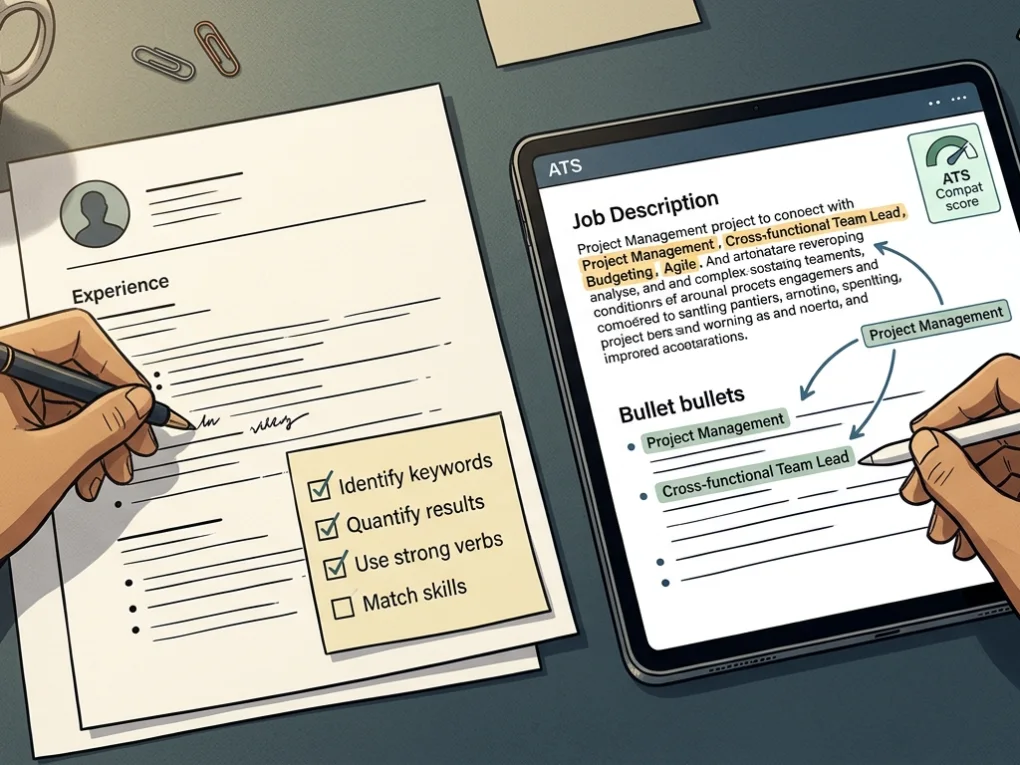
Step 3: Tailor Your Bullets to the Job Description (Beat the ATS)
Most mid-to-large companies use Applicant Tracking Systems (ATS) to parse and rank resumes before a human ever sees them.
Scan your target job posting and highlight the core competencies, software tools, and industry methodologies mentioned. Weave those exact keywords naturally into your bullet points. For example, if the job description asks for “Cross-functional stakeholder management” and “Jira,” don’t just put them in a skills list—show how you used them in your experience bullets.
Step 4: Keep Every Line Concise and Scannable
Long, winding paragraphs defeat the purpose of using bullet points. Adhere to strict formatting boundaries:
- Length: Limit each bullet point to 1 to 2 lines (roughly 15–20 words). If a bullet spills onto a third line with just two words, trim the fluff.
- Grammar: Write in crisp sentence fragments. Omit personal pronouns like “I,” “my,” “we,” or “our”—the recruiter already knows the resume is about you.
- Clarity: Cut subjective adjectives like “hardworking” or “synergistic” in favor of concrete nouns and verbs.
Step 5: Structure and Order Your Sections Strategically
Knowing how many bullets to include directly impacts How Long Should a Resume Be. Too many bullets create a wall of text; too few make your experience look thin.
- Recent/Relevant Roles: Include 3 to 5 bullet points per job.
- Older or Less Relevant Roles: Condense to 2 bullet points (or group early-career roles into a brief “Additional Experience” section).
- Priority Ordering: Always place your most impressive, relevant achievement as the first bullet point under each role. Do not order bullets chronologically by when you did the task.
(Note: If you are applying for academic, medical, or international research roles, your formatting rules will differ—check out our guide on resume vs CV to see when comprehensive lists are preferred over concise bullets.)
Before and After: Real Resume Bullet Point Examples
Seeing the formulas in action makes it much easier to rewrite your own experience. Look at how these common, duty-based bullets transform into interview-winning statements:
Customer Service & Operations
-
❌ Weak (Duty-Based): “Handled customer complaints and answered phone calls.”
-
✅ Strong (Accomplishment-Based): “Resolved over 50 escalated customer service tickets weekly, raising the branch customer satisfaction score from 82% to 94%.”
Marketing & Social Media
-
❌ Weak (Duty-Based): “Worked on the marketing team to post on social media.”
-
✅ Strong (Accomplishment-Based): “Spearheaded a B2B LinkedIn content strategy that grew follower engagement by 150% and generated 40+ qualified sales leads in four months.”
Administration & Project Management
-
❌ Weak (Duty-Based): “Scheduled meetings and organized files for the department.”
-
✅ Strong (Accomplishment-Based): “Reorganized shared cloud filing architecture for a 35-person department, reducing document retrieval time and saving an estimated 5 hours per week.”
Software & IT
-
❌ Weak (Duty-Based): “Wrote code and fixed bugs for the company mobile app.”
-
✅ Strong (Accomplishment-Based): “Refactored legacy checkout code in React Native, reducing app crash rates by 60% and boosting mobile checkout completion by 18%.”
Frequently Asked Questions (FAQ)
How many bullet points should I have per job on a resume?
Aim for 3 to 5 bullet points for your current and most relevant past positions. For older roles (over 7–10 years ago) or jobs less relevant to your target career, limit yourself to 1 to 2 bullet points so your most important achievements stand out.
Should resume bullet points have periods at the end?
Both styles are acceptable, provided you remain 100% consistent throughout your entire document. Because resume bullet points are technically sentence fragments rather than complete grammatical sentences, many modern career coaches prefer omitting periods for a cleaner visual scan. Whichever you choose, never mix punctuated and unpunctuated bullets.
How do I write resume bullet points if my job has no metrics?
Even if you don’t track revenue or KPIs, you can still show scope and qualitative impact. Quantify the scale of your work (e.g., “Supported 4 executives,” “Trained 6 new hires,” “Managed a calendar of 30+ weekly appointments”) or highlight the qualitative outcome (e.g., “Selected by management to lead the safety committee,” or “Completed store remodel two days ahead of schedule”).
Can I use AI to write my resume bullet points?
Yes, AI tools and a modern resume builder are fantastic for overcoming writer’s block and suggesting strong action verbs. However, never use raw AI output without editing it. Always verify that the metrics are accurate to your real-life experience and adjust the tone so it sounds natural and human.
Writing strong bullet points doesn’t require embellishing your career—it simply requires giving yourself credit for the results of your hard work. When you swap out passive job duties for active verbs, clear formulas, and hard numbers, you make it effortless for a hiring manager to picture the value you’ll bring to their team.
Ready to build a polished, recruiter-approved resume in minutes? Stop fighting with margins and formatting. Head over to the SonCV Resume Builder to access ATS-friendly templates, smart bullet point suggestions, and expert tools designed to get you hired faster!