Resume Summary Examples: How to Write a High-Impact Hook (With 25+ Templates)
 Angelina Koss11 min read
A resume summary is a concise, 2-to-4 sentence paragraph at the very top of your resume that highlights your job title, years of experience, core skills, and a major quantifiable achievement. Acting as your professional elevator pitch, a strong summary immediately shows hiring managers and Applicant Tracking Systems (ATS) the exact value you bring to the role.
When a recruiter opens your application, your top section does the heavy lifting. According to career guides from Harvard Business Review, the first 15 to 20 words of your resume matter most. If those words are stuffed with empty clichés like “hard-working team player seeking a challenging position,” the reader moves on. If they lead with clear identity and hard numbers, you earn a full read.
Whether you are mastering how to write a resume from scratch or refreshing an outdated header, this guide breaks down the exact formula recruiters look for—complete with copy-and-paste resume summary examples for every career stage.
The 3-Layer Formula for a Winning Resume Summary
Top career hubs, including Indeed and Duke University Career Hub, agree that the best resume summary statements aren’t written from scratch—they are assembled using a repeatable structure.
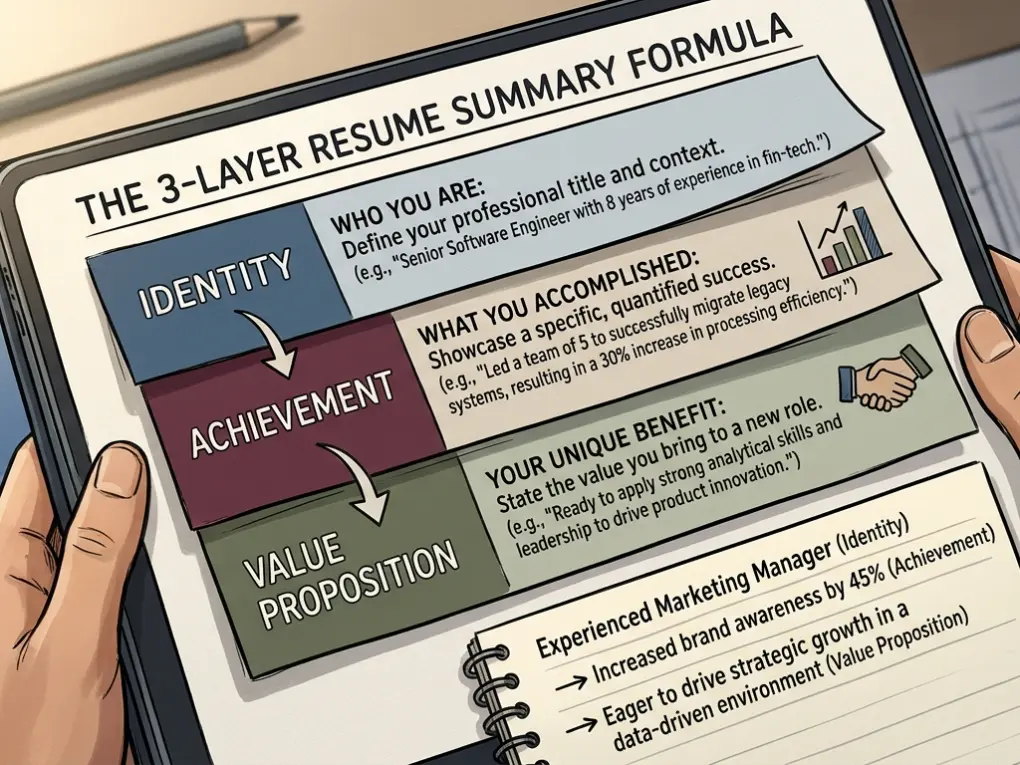
To write a summary in under five minutes, use the 3-Layer Formula:
-
Layer 1: Identity (Who You Are): State your target job title, years of experience, and industry or operational scale. Always lead with a strong noun phrase that matches the job posting.
-
Example: “Senior Software Engineer with 7 years of backend development experience in high-volume fintech environments…”
-
-
Layer 2: Achievement (Your Strongest Proof): Share one or two specific accomplishments backed by numbers, percentages, dollar amounts, or time saved.
-
Example: “…who rebuilt payment processing architecture, reducing transaction errors by 90% across 2 million daily requests.”
-
-
Layer 3: Value Proposition (What You Bring): Name 2 to 3 core technical skills, tools, or certifications from the job description, tied directly to the employer’s goals.
-
Example: “Skilled in Python, Go, and AWS cloud migrations, focused on scaling reliable enterprise infrastructure.”
-
Resume Summary vs. Resume Objective: Which Do You Need?
Job seekers often confuse a professional summary with a resume objective. While both sit at the top of the page, they serve completely different purposes.
| Feature | Resume Summary | Resume Objective |
| Core Focus | What you can contribute to the employer (value and proof). | What you want from the employer (career goals). |
| Best Used By | Experienced professionals, career changers, and grads with project/internship metrics. | Entry-level applicants with zero relevant projects or someone relocating/changing tracks completely. |
| ATS Impact | High—naturally packs role titles, hard skills, and measurable outcomes. | Low to Medium—often relies on generic aspirational phrasing. |
| Example | “Digital Marketer with 4 years of experience running B2B paid social campaigns, averaging a 3.2x return on ad spend.” | “Seeking a marketing position at a growing agency where I can develop my skills.” |
The Verdict: Use a resume summary in almost all cases. Even if you are a recent graduate, leading with academic projects, clinical hours, or internship numbers is far more persuasive than stating that you want a job. (If you are applying for academic or international fellowships, make sure you also understand the resume vs CV distinction before choosing your header format.)
Resume Summary Examples by Experience Level
Use these verified templates as a starting point. Swap out the bracketed metrics and tool names to match your background.
Entry-Level, Students & Recent Graduates
If you have less than two years of work history, lead with your degree, internships, clinical rotations, or deployed projects rather than years on the job.
- Digital Marketing Student / Graduate: “Recent Marketing graduate with two agency internships specializing in social media and content strategy. Grew a client’s Instagram following from 1,100 to 14,000 in five months and produced 60+ pieces of short-form video content. Proficient in Meta Ads Manager, Canva, and on-page SEO.”
- Entry-Level Software Engineer: “Computer Science graduate with a 4-month backend internship at a logistics startup and three deployed web applications. Built an inventory API handling 40,000 daily requests and wrote integration tests that lifted team test coverage to 80%. Strong foundation in Python, React, and SQL.”
- Entry-Level Registered Nurse (RN): “Licensed Registered Nurse (RN) with 600+ clinical hours across medical-surgical and ICU rotations. Recognized by clinical preceptors for rapid triage assessment and maintaining calm communication during high-acuity emergencies. Trained in Epic EMR documentation and patient family education.”
- Junior Data / Business Analyst: “Business Analytics graduate with hands-on SQL, Python, and Power BI experience across three capstone projects analyzing over 1.2 million sales records. Built an automated reporting dashboard during a summer placement that saved the merchandising team 20 hours per month.”
Mid-to-Senior Level Professionals
When you have 3 to 10+ years of experience, anchor your summary around team scope, budget sizes, revenue growth, or process efficiency.
- Project Manager: “Project Manager with 7 years of experience delivering enterprise software implementations for Fortune 500 clients. Managed cross-functional teams of up to 25 and project budgets ranging from $500K to $4M, achieving a 96% on-time delivery rate. Certified PMP skilled in Agile and Waterfall methodologies, risk mitigation, and stakeholder alignment.”
- Mid-Level Finance & Accounting Specialist: “Financial Analyst with 5 years of experience in corporate FP&A and multi-site budget forecasting. Rebuilt the monthly financial reporting workflow, consolidating 14 manual spreadsheets into a single automated model that cut closing time by 3 days. Expert in SAP, advanced Excel modeling, and variance analysis.”
- Senior Content & SEO Marketer: “Content Marketing Manager with 6 years of experience scaling organic acquisition for B2B SaaS brands. Scaled organic search traffic from 12,000 to 180,000 monthly visitors in 18 months through technical SEO audits and topic cluster strategies. Skilled in Ahrefs, GA4, and conversion rate optimization.”
- Operations & Logistics Manager: “Operations Manager with 9 years in multi-site manufacturing and distribution, leading a 45-person team across three regional centers. Improved on-time delivery from 78% to 94% without increasing headcount while cutting overtime costs by 18% through shift re-planning. Adept in Lean methodologies and ERP systems.”
- Customer Success Manager: “Customer Success Manager with 5 years of experience in HR technology, owning a $1.8M portfolio across 34 enterprise accounts. Maintained 94% gross retention through a company-wide pricing transition and lifted expansion revenue by 12% via data-driven Quarterly Business Reviews (QBRs).”
Career Changers (Transferable Skills Focus)
When pivoting industries, name your target role in sentence one, then bridge your past achievements to the new field’s requirements.
- Retail Manager to Corporate Operations / Account Management: “Operations and Client Relations professional with 8 years of experience leading high-volume retail teams of 28+ staff and managing a $3.6M annual P&L. Proven track record of reducing employee turnover by 35% through structured onboarding and exceeding annual revenue targets by 20%. Leveraging strong vendor negotiation, CRM, and scheduling expertise to drive operational efficiency in corporate account management.“
- Teacher to Corporate Instructional Designer / Training Manager: “Training and Development Specialist with 6 years of experience designing curriculum and leading instruction for diverse cohorts of 120+ learners. Spearheaded a digital learning transition that improved assessment pass rates by 22% and cut onboarding prep time in half. Skilled in Articulate Storyline, LMS administration, and adult learning principles.“
- Hospitality / Customer Service to SaaS Support Lead: “Customer Support Specialist with 4 years of experience resolving 80+ daily inquiries in high-pressure hospitality and retail environments while maintaining a 4.7/5 satisfaction score. Trained 10+ new hires on POS and refund workflows and introduced response templates that cut resolution times by 25%. Proficient in Salesforce CRM, Zendesk, and conflict de-escalation.”
Resume Summary Examples by Core Industry
Need something more specific? Here are targeted examples across high-demand sectors:
- Full-Stack / Frontend Developer: “React Developer with 4 years of experience building accessible web applications. Led a flagship e-commerce checkout redesign that boosted mobile conversion rates by 22% and reduced page load times by 1.4 seconds. Proficient in TypeScript, Next.js, and CI/CD pipelines.”
- DevOps / Cloud Engineer: “DevOps Engineer with 6 years of cloud infrastructure experience. Migrated a 50-service architecture to AWS with zero downtime, cutting monthly cloud spend by 35%. Skilled in Kubernetes, Terraform, Docker, and automated incident response.”
- Executive Assistant / Office Manager: “Executive Assistant with 7 years of experience supporting C-Suite leaders across four international time zones. Manage complex calendars of 60+ weekly meetings and overhauled travel expense workflows, cutting reimbursement approval time from 9 days to 2. Reduced annual office vendor expenses by 18%.“
- B2B Sales / Account Executive: “Enterprise Account Executive with 7 years of experience selling B2B SaaS solutions into healthcare and fintech verticals. Consistently achieved 130%+ of annual quota, closing $2.4M in net-new ARR last fiscal year. Expert in consultative MEDDIC selling, Salesforce CRM, and C-level contract negotiation.”
- Human Resources / Talent Acquisition Specialist: “Talent Acquisition Partner with 5 years of experience managing full-cycle recruiting for high-growth tech teams. Filled 100+ technical and commercial roles annually with a 95% first-year retention rate. Implemented a new ATS workflow in Greenhouse that reduced time-to-hire by 30%.”
- Graphic & Product Designer: “Senior Product Designer with 8 years of experience crafting complex data interfaces for B2B platforms. Led the UX overhaul of a core analytics dashboard used by 8,000 daily active users, increasing task completion by 24% and cutting support tickets by 31%. Expert in Figma, design systems, and user usability testing.”
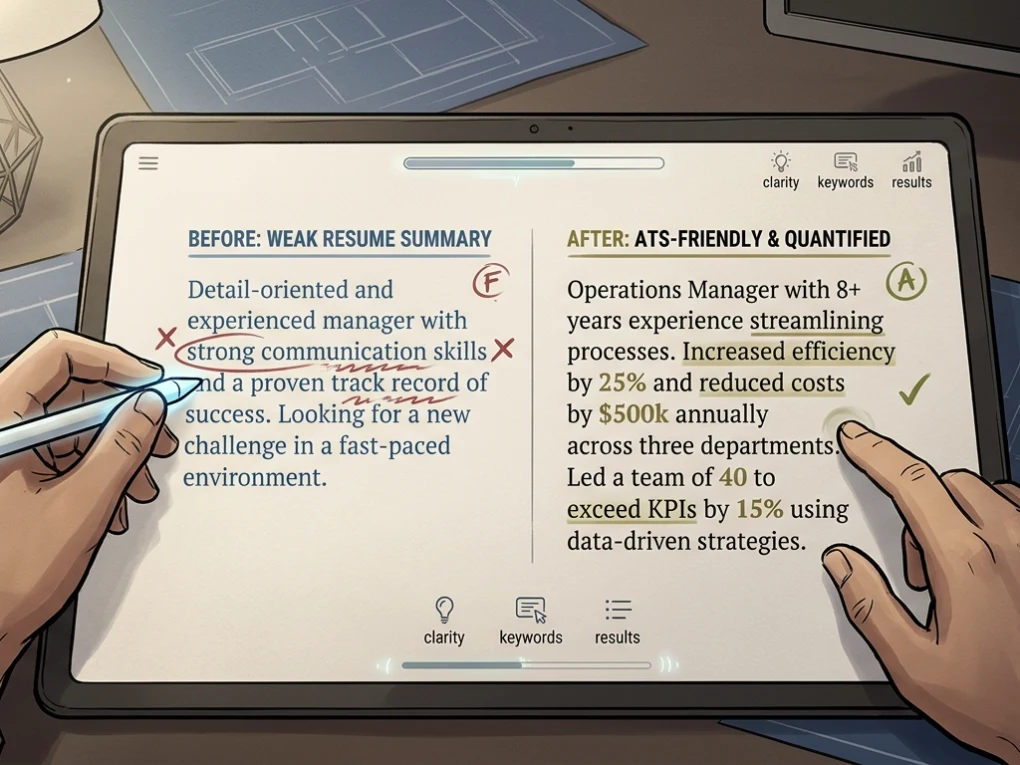
Before & After: Fixing Common Resume Summary Mistakes
The fastest way to understand what makes a summary work is to see how a generic draft transforms into a high-converting pitch.
| Weak Summary (What to Avoid) | Strong Summary (What Gets Interviews) | Why It Works |
| “I am a hard-working customer service representative with great communication skills looking for a role where I can grow.” | “Customer Support Lead with 6 years of SaaS experience coaching 12 agents. Raised CSAT from 82% to 91% across 3,000 monthly tickets by introducing automated triage templates.” | Drops pronouns (“I am”), cuts vague personality claims, and proves reliability with ticket volume and CSAT percentages. |
| “Results-oriented logistics professional responsible for managing warehouse shipments and staff schedules.” | “Logistics Coordinator with 4 years in FMCG distribution, managing 12,000 weekly orders at 99.9% picking accuracy. Cut pallet-handling damage by 22% by redesigning loading floor plans.” | Replaces “responsible for” with concrete weekly volume, accuracy rates, and a specific operational cost win. |
5 Quick Rules to Follow Before You Hit Send
- Eliminate Personal Pronouns: Never use “I,” “me,” “my,” or “we.” Write in implied first person (also called third-person voice without pronouns), starting sentences with strong noun phrases or action verbs like Managed, Built, Reduced, or Scaled.
- Ban Empty Buzzwords: Words like “dynamic self-starter,” “synergy,” “go-getter,” and “results-oriented team player” take up valuable space without proving anything. Replace every adjective with a number.
- Write It Last: Always write your summary after you have finished your work experience section. It is much easier to cherry-pick your top two metrics once your bullet points are already on the page.
- Tailor the Final Sentence for Every Job: It takes less than three minutes to swap out the 2–3 core skills in your final sentence so they mirror the exact phrasing in the employer’s job posting. This simple habit dramatically improves ATS alignment.
- Keep the Length Tight: Stick to 2 to 4 sentences (roughly 50 to 80 words) or 3 concise bullet points. A bloated paragraph pushes your work history down the page—and if you are wondering how your header impacts your overall page count, check out our guide on How Long Should a Resume Be.
Frequently Asked Questions (FAQ)
Should I put a summary on my resume in 2026?
Yes. A tailored resume summary remains one of the most effective ways to pass ATS keyword filters and immediately orient human recruiters. As long as it is packed with specific metrics and role-relevant skills rather than generic fluff, it provides an instant snapshot of your seniority and value.
Can I use bullet points for my resume summary?
Absolutely. A bulleted summary (3 to 4 crisp bullet points at the top of your resume) is an excellent format for career changers, entry-level candidates, or professionals who want to highlight distinct qualifications that don’t flow easily in a single paragraph.
How do I write a resume summary with no experience?
Focus on your education, relevant coursework, academic capstone projects, volunteer leadership, or internships. State your degree and target field in the first sentence, highlight a quantified project outcome in the second (e.g., “Analyzed 50,000+ rows of survey data in Excel”), and list your technical or transferable skills in the third.
Should I use the same resume summary for every job application?
No. While your core identity and biggest achievement can stay consistent, you should tweak your job title (Sentence 1) and your key skills list (Sentence 3) to match the exact terminology used in each target job description.
Your resume summary is the headline of your career story. By ditching first-person pronouns, cutting out overused buzzwords, and following the 3-Layer Formula (Identity + Quantified Achievement + Value Proposition), you turn the top third of your resume into an interview-generating asset.
Ready to build your custom resume summary? Don’t stare at a blank page. Drop your current job title, years of experience, top achievement, and target role into our builder—or share them right here—and let’s craft a tailored, ATS-ready resume summary that puts your application at the top of the stack.